
Why Index Funds are Ideal for Early Retirement
Planning for early retirement, often associated with the FIRE (Financial Independence, Retire Early) movement, requires a strategic and efficient investment approach. Index funds have emerged as a cornerstone of many early retirement strategies due to their low cost, diversification, and passive management style. These features align perfectly with the long-term investment horizon required to accumulate sufficient wealth for early retirement.
Unlike actively managed funds, which aim to beat the market through stock picking, index funds track a specific market index, such as the S&P 500 or the total stock market. This passive approach significantly reduces management fees, often the largest drag on investment returns. Lower fees translate to more of your investment dollars compounding over time, a crucial factor when aiming for early retirement.
Furthermore, index funds offer instant diversification, spreading your investment across a wide range of companies or assets. This reduces the risk associated with individual stock selection and helps to smooth out the volatility of your portfolio. Diversification is particularly important when you are relying on your investments to provide income during your retirement years.
Key Considerations When Choosing Index Funds for Early Retirement
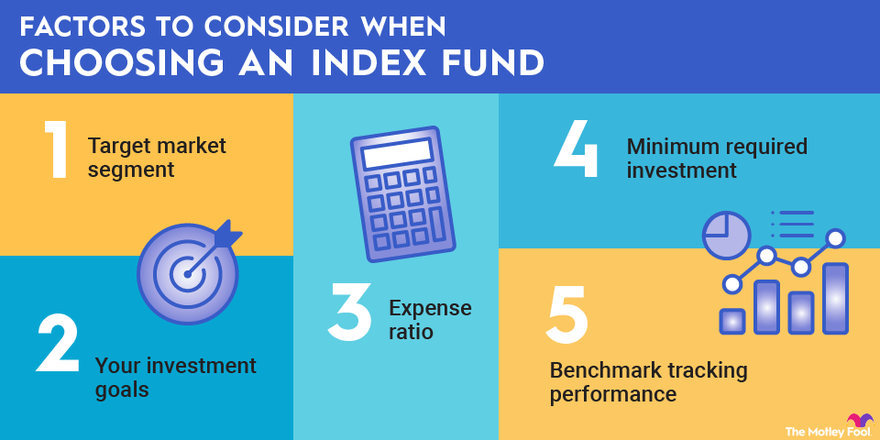
Selecting the right index funds for your early retirement portfolio involves careful consideration of several factors, including your risk tolerance, investment timeline, and desired asset allocation. Here are some key considerations:
Asset Allocation
Your asset allocation, the proportion of your portfolio allocated to different asset classes such as stocks, bonds, and real estate, is the most important determinant of your investment returns. For early retirement, a generally accepted strategy involves a higher allocation to stocks, especially in the early stages of your accumulation phase, to maximize growth potential. As you approach your retirement date, you may gradually shift towards a more conservative allocation with a higher proportion of bonds to reduce volatility and preserve capital.
Expense Ratios
Expense ratios, the annual fees charged by the fund to cover its operating expenses, can have a significant impact on your long-term returns. Opt for index funds with the lowest possible expense ratios to minimize the drag on your investment performance. Even seemingly small differences in expense ratios can accumulate to substantial sums over decades.
Tracking Error
Tracking error measures how closely an index fund follows the performance of its underlying index. A lower tracking error indicates that the fund is effectively replicating the index's returns. While some tracking error is inevitable, choose funds with a history of low tracking error to ensure that you are capturing the intended market performance.
Tax Efficiency
Index funds are generally more tax-efficient than actively managed funds due to their lower turnover rates. Lower turnover means fewer capital gains distributions, which can reduce your tax liability. However, it is still important to hold your index funds in tax-advantaged accounts, such as 401(k)s or IRAs, to maximize your tax savings.
Top Index Fund Recommendations for Early Retirement
Based on the above considerations, here are some of the best index funds for early retirement, categorized by asset class:
U.S. Total Stock Market Index Funds
These funds provide broad exposure to the entire U.S. stock market, including large-cap, mid-cap, and small-cap stocks. They are an excellent core holding for any early retirement portfolio.
- Vanguard Total Stock Market Index Fund ETF (VTI): This ETF tracks the CRSP US Total Market Index and offers extremely low expense ratio.
- Schwab Total Stock Market Index Fund (SWTSX): A mutual fund version with a similarly low expense ratio, suitable for those who prefer mutual funds over ETFs.
- Fidelity ZERO Total Market Index Fund (FZROX): This fund boasts a zero expense ratio, making it an incredibly attractive option. However, it's only available through Fidelity.
S&P 500 Index Funds
These funds track the S&P 500 index, which represents the 500 largest publicly traded companies in the United States. They are a popular choice for investors seeking exposure to the large-cap segment of the U.S. stock market.
- Vanguard S&P 500 ETF (VOO): Another low-cost ETF from Vanguard that tracks the S&P 500.
- iShares CORE S&P 500 ETF (IVV): A highly liquid and widely traded ETF tracking the S&P 500.
- SPDR S&P 500 ETF Trust (SPY): The oldest and most actively traded S&P 500 ETF.
International Stock Market Index Funds
Investing in international stocks is crucial for diversifying your portfolio and capturing growth opportunities outside of the U.S.
- Vanguard Total International Stock ETF (VXUS): This ETF provides exposure to a broad range of international stocks, including both developed and emerging markets.
- Schwab Total International Stock Market Index Fund (SWISX): A mutual fund alternative to VXUS with a competitive expense ratio.
- iShares MSCI EAFE ETF (EFA): Focuses on developed markets outside of North America.
U.S. Bond Market Index Funds
Bonds play an important role in reducing portfolio volatility and providing income, particularly as you approach retirement.
- Vanguard Total Bond Market ETF (BND): This ETF tracks the Bloomberg Barclays U.S. Aggregate Bond Index, providing exposure to a wide range of investment-grade U.S. bonds.
- Schwab U.S. Aggregate Bond Index Fund (SWAGX): A mutual fund version with a low expense ratio.
- iShares CORE U.S. Aggregate Bond ETF (AGG): A popular and liquid bond ETF.
Real Estate Index Funds (REITs)
Real estate investment trusts (REITs) offer exposure to the real estate market without directly owning properties. They can provide diversification and income potential.
- Vanguard Real Estate ETF (VNQ): This ETF tracks the MSCI US Investable Market Real Estate 25/50 Index, providing exposure to a broad range of REITs.
- iShares CORE U.S. REIT ETF (USRT): Another popular REIT ETF with a diversified portfolio.
Building Your Early Retirement Portfolio with Index Funds
Once you have selected your index funds, the next step is to build a diversified portfolio that aligns with your risk tolerance and investment goals. A common approach is to use a three-fund portfolio, consisting of:
- U.S. Total Stock Market Index Fund: For broad exposure to the U.S. stock market.
- International Stock Market Index Fund: For diversification and exposure to international growth.
- U.S. Bond Market Index Fund: For stability and income.
The specific allocation to each fund will depend on your individual circumstances. Younger investors with a longer time horizon may allocate a higher percentage to stocks, while those closer to retirement may allocate a higher percentage to bonds.
Remember to rebalance your portfolio periodically to maintain your desired asset allocation. This involves selling some of the assets that have performed well and buying more of the assets that have underperformed. Rebalancing helps to ensure that your portfolio stays aligned with your risk tolerance and investment goals.
By carefully selecting and allocating index funds, you can build a solid foundation for your early retirement journey. Remember to consult with a financial advisor to get personalized advice based on your specific circumstances.

0 Comments