
Navigating the Stock Market: A Beginner's Guide to Key Terms
The stock market can seem daunting, especially for beginners. The jargon alone can be overwhelming! But understanding the fundamentals is crucial for making informed investment decisions. This glossary aims to demystify the stock market by explaining essential terms in a clear and concise manner. This guide to stock market investing for beginners will help you get started.
Essential Stock Market Terms
Assets
An asset is anything you own that has value. In the context of the stock market, assets can include stocks, bonds, real estate, and other investments.
Bonds
A bond is a debt instrument issued by a corporation or government. When you buy a bond, you are essentially lending money to the issuer, who promises to repay the principal amount along with interest over a specified period.
Broker
A broker is a firm or individual that acts as an intermediary between buyers and sellers of stocks and other securities. Brokers execute trades on behalf of their clients and may also provide investment advice.
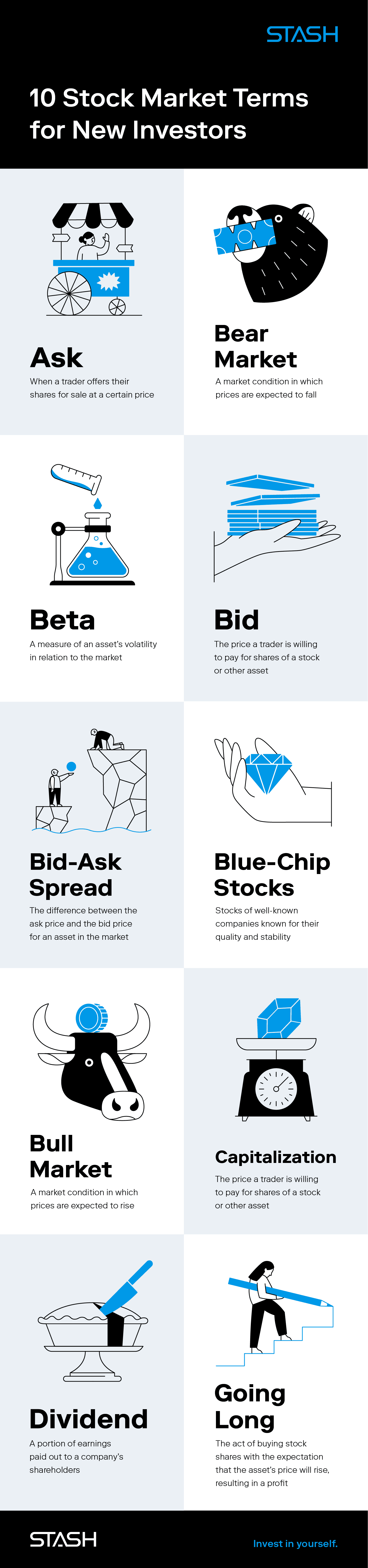
Bear Market
A bear market is a prolonged period of declining stock prices, typically characterized by a drop of 20% or more from recent highs. Bear markets are often associated with economic downturns and investor pessimism.
Bull Market
A bull market is the opposite of a bear market, representing a sustained period of rising stock prices. Bull markets are typically associated with economic growth and investor optimism.
Capital Gains
Capital gains are the profits you make when you sell an asset, such as a stock, for more than you paid for it. Capital gains are subject to taxes.
Capital Loss
A capital loss occurs when you sell an asset for less than you paid for it. Capital losses can be used to offset capital gains for tax purposes.
Dividends
Dividends are payments made by a company to its shareholders, typically from the company's profits. Dividends are usually paid on a quarterly basis.
Diversification
Diversification is a risk management strategy that involves spreading your investments across a variety of assets to reduce the impact of any single investment on your overall portfolio. A diversified portfolio can include stocks, bonds, real estate, and other asset classes.
Exchange-Traded Fund (ETF)
An ETF is a type of investment fund that holds a basket of assets, such as stocks or bonds, and trades on stock exchanges like individual stocks. ETFs offer diversification and can be a cost-effective way to invest in a particular sector or market.
Fundamental Analysis
Fundamental analysis is a method of evaluating securities by analyzing a company's financial statements, management, and competitive environment. The goal of fundamental analysis is to determine the intrinsic value of a stock and identify investment opportunities.
Index Fund
An index fund is a type of mutual fund or ETF that tracks a specific market index, such as the S&P 500. Index funds aim to replicate the performance of the index they track and typically have lower fees than actively managed funds.
Initial Public Offering (IPO)
An IPO is the first time a private company offers shares to the public. IPOs can be a way for companies to raise capital and for investors to gain access to potential growth opportunities.
Liquidity
Liquidity refers to how easily an asset can be bought or sold without affecting its price. Stocks are generally considered to be more liquid than real estate, for example.
Market Capitalization
Market capitalization (or market cap) is the total value of a company's outstanding shares of stock. It is calculated by multiplying the number of outstanding shares by the current share price. Market capitalization is often used to classify companies as small-cap, mid-cap, or large-cap.
Mutual Fund
A mutual fund is a type of investment fund that pools money from multiple investors to purchase a portfolio of stocks, bonds, or other assets. Mutual funds are managed by professional fund managers.
Portfolio
A portfolio is a collection of investments owned by an individual or institution. A well-diversified portfolio can help reduce risk and improve returns.
Price-to-Earnings Ratio (P/E Ratio)
The P/E ratio is a valuation metric that compares a company's stock price to its earnings per share (EPS). It is used to determine how much investors are willing to pay for each dollar of earnings. A higher P/E ratio may indicate that a stock is overvalued, while a lower P/E ratio may indicate that it is undervalued.
Return on Investment (ROI)
ROI is a measure of the profitability of an investment. It is calculated by dividing the net profit by the cost of the investment.
Risk Tolerance
Risk tolerance refers to an investor's ability and willingness to withstand losses in their investments. Investors with a high risk tolerance may be willing to invest in more volatile assets, while those with a low risk tolerance may prefer more conservative investments.
Securities and Exchange Commission (SEC)
The SEC is a U.S. government agency that regulates the securities industry and protects investors. The SEC requires companies to disclose financial information and enforces laws against insider trading and other fraudulent activities.
Stock
A stock is a share of ownership in a company. When you buy stock, you become a shareholder and are entitled to a portion of the company's profits and assets.
Technical Analysis
Technical analysis is a method of evaluating securities by analyzing historical price and volume data. Technical analysts use charts and other tools to identify patterns and trends in the market and predict future price movements.
Volatility
Volatility refers to the degree of price fluctuations in an asset. Highly volatile assets are considered to be riskier than less volatile assets.
Yield
Yield is the income return on an investment, typically expressed as a percentage. For example, the dividend yield of a stock is the annual dividend payment divided by the stock price.
Taking the First Steps
Understanding these fundamental terms is the first step towards becoming a successful stock market investor. Remember to do your research, diversify your portfolio, and invest for the long term. Consider consulting with a financial advisor to get personalized advice based on your individual circumstances and financial goals. Investing in the stock market involves risk, and it is possible to lose money. However, with a solid understanding of the basics and a disciplined approach, you can increase your chances of achieving your financial objectives through stock market investing.

0 Comments