
Understanding Early Retirement Withdrawal Penalties
Planning for retirement is a significant undertaking, and sometimes life throws curveballs that make early retirement seem like the only option. However, accessing your retirement funds before the designated age often comes with a hefty price: early withdrawal penalties. These penalties can significantly reduce your retirement savings, so understanding them is crucial before making any decisions. This article delves into the complexities of early retirement withdrawal penalties, helping you navigate the rules and regulations surrounding them.
What Constitutes an Early Withdrawal?
Generally, an early withdrawal refers to taking money from your retirement accounts, such as a 401(k) or IRA, before you reach age 59 ½. The IRS defines this age as the threshold, and withdrawing funds before this age typically triggers a penalty. This penalty is in addition to any regular income taxes you owe on the withdrawn amount. The purpose of this penalty is to discourage individuals from using their retirement savings for non-retirement expenses.
The Standard 10% Penalty
The most common penalty for early withdrawals is 10% of the withdrawn amount. This penalty applies to most distributions from traditional 401(k)s, traditional IRAs, and other qualified retirement plans. For example, if you withdraw $50,000 from your 401(k) before age 59 ½, you could face a $5,000 penalty on top of the income taxes you'll owe on the $50,000 distribution.
Types of Retirement Accounts Affected
The 10% early withdrawal penalty generally applies to the following types of retirement accounts:
- Traditional 401(k)s
- Traditional IRAs
- SEP IRAs
- SIMPLE IRAs
It's important to note that the rules and penalties can vary slightly depending on the specific type of account. For example, SIMPLE IRAs may have a higher penalty (25% within the first two years of participation). Always consult with a financial advisor or tax professional to understand the specific rules pertaining to your retirement accounts.
Exceptions to the Early Withdrawal Penalty
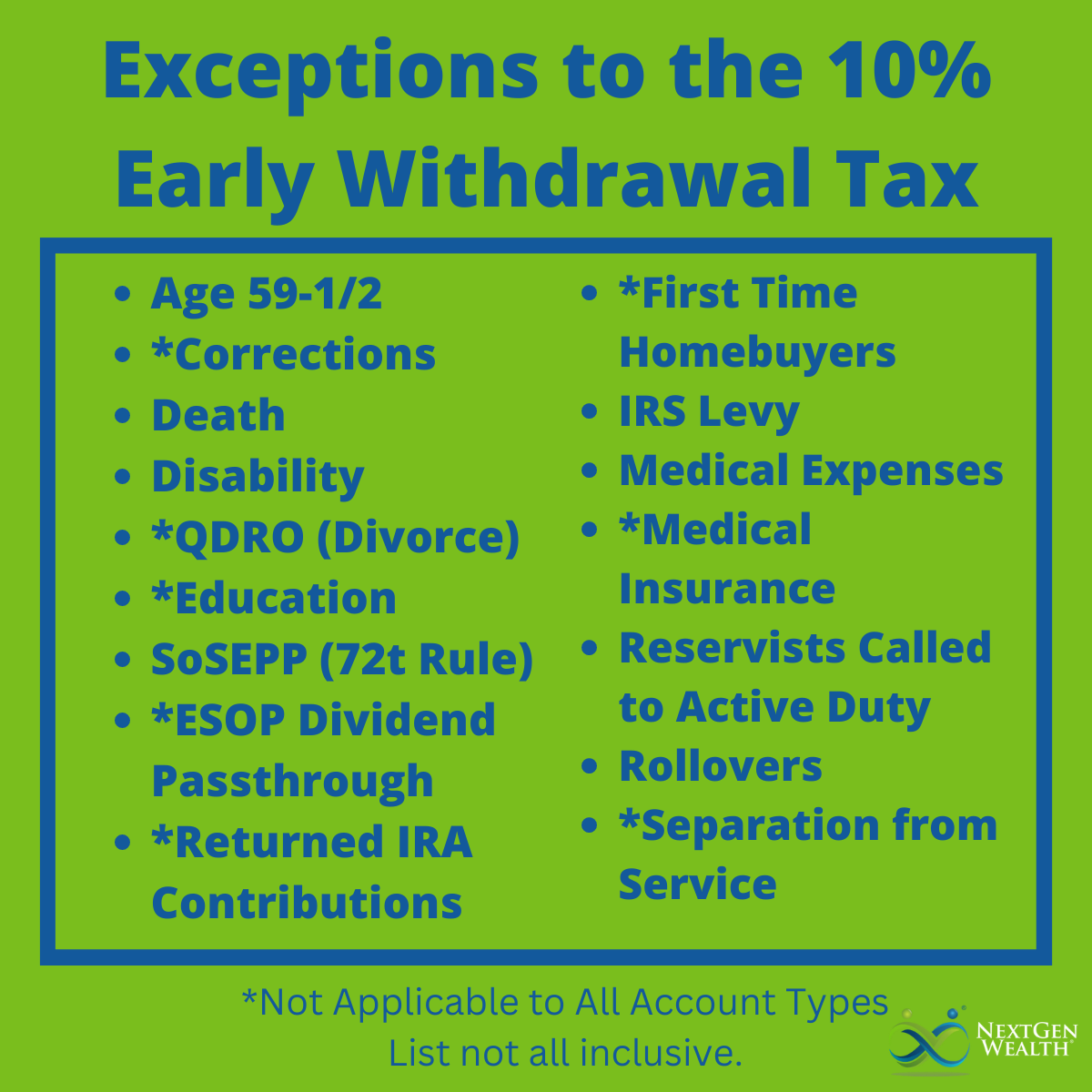
Fortunately, there are several exceptions to the early withdrawal penalty. Understanding these exceptions is critical, as they could potentially save you thousands of dollars. Here are some common exceptions:
Substantially Equal Periodic Payments (SEPP)
Also known as Rule 72(t), this exception allows you to take distributions from your retirement account before age 59 ½ without incurring the 10% penalty, provided you take a series of substantially equal periodic payments. These payments must be calculated using one of three IRS-approved methods and continue for at least five years or until you reach age 59 ½, whichever is later. Modifying or stopping the payments before the required period can result in retroactive penalties.
Medical Expenses
You can avoid the penalty if you use the withdrawal to pay for unreimbursed medical expenses that exceed 7.5% of your adjusted gross income (AGI). This exception is designed to help individuals facing significant medical costs. Keep detailed records of your medical expenses to support your claim.
Disability
If you become permanently and totally disabled, you can withdraw funds from your retirement account without penalty. You must provide documentation from a physician certifying your disability.
Death
If you inherit a retirement account and are not the spouse of the deceased, you may be subject to different rules for withdrawals, but the 10% penalty does not apply. However, income taxes will still be due on the distributed amount.
Qualified Domestic Relations Order (QDRO)
If you withdraw funds from your retirement account pursuant to a QDRO, which is a court order issued in connection with a divorce, the 10% penalty does not apply.
Qualified Reservist Distributions
If you are a member of the military reserves and are called to active duty for more than 179 days, you may be able to withdraw funds from your retirement account without penalty.
Birth or Adoption Expenses
The SECURE Act 2.0 allows for penalty-free withdrawals of up to $5,000 for qualified birth or adoption expenses. This exception can provide much-needed financial relief for new parents.
First-Time Homebuyer
For IRAs (but not 401(k)s), you can withdraw up to $10,000 penalty-free to buy, build, or rebuild a first home. This exception is subject to certain requirements and limitations.
Higher Education Expenses
While not always the best strategy, you can withdraw funds from an IRA (but not typically 401(k)s) to pay for qualified higher education expenses for yourself, your spouse, your children, or your grandchildren. However, consider alternative funding options like student loans before tapping into your retirement savings.
Minimizing the Impact of Early Withdrawals
Even if you qualify for an exception to the early withdrawal penalty, it's crucial to minimize the amount you withdraw. Here are some strategies to consider:
- Explore alternative funding sources: Before tapping into your retirement accounts, explore other options such as personal loans, lines of credit, or selling assets.
- Consider a Roth IRA conversion: While converting a traditional IRA to a Roth IRA requires paying income taxes on the converted amount, future withdrawals from the Roth IRA will be tax-free and penalty-free, provided you meet certain requirements.
- Work with a financial advisor: A financial advisor can help you assess your financial situation and develop a plan to minimize the impact of early withdrawals on your retirement savings.
Reporting Early Withdrawals on Your Taxes
When you take an early withdrawal from your retirement account, you'll need to report it on your tax return. You'll receive Form 1099-R from the financial institution that holds your retirement account, which will detail the amount of the withdrawal and any taxes withheld. You'll use this information to complete Form 5329, Additional Taxes on Qualified Plans (Including IRAs) and Other Tax-Favored Accounts, to calculate and report any penalties owed. Be sure to keep accurate records of your withdrawals and any supporting documentation for claiming an exception to the penalty.
The Importance of Long-Term Planning
While early retirement withdrawals may sometimes be necessary, they should be considered a last resort. Dipping into your retirement savings early can significantly impact your long-term financial security. Careful planning and budgeting are essential to avoid the need for early withdrawals. Consider consulting with a financial advisor to develop a comprehensive retirement plan that meets your individual needs and goals. They can help you explore strategies to maximize your savings, minimize taxes, and navigate the complexities of retirement planning.

0 Comments