
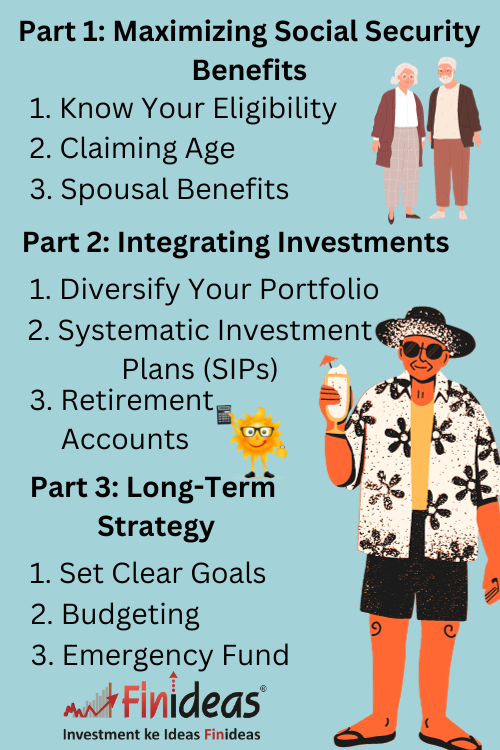
Understanding Social Security Benefits and Your Retirement
Social Security benefits are a crucial component of retirement income for many Americans. However, navigating the complexities of Social Security can be daunting. Knowing how to strategically invest and plan can significantly impact the amount you receive and help you maximize your lifetime benefits. This article explores investment strategies that can complement your Social Security income and enhance your overall retirement security.
Delaying Benefits: A Powerful Investment Strategy
One of the most effective strategies for maximizing your Social Security benefits is simply delaying when you start receiving them. While you can begin receiving benefits as early as age 62, your benefit amount will be significantly reduced. Waiting until your full retirement age (FRA), which is 66 or 67 depending on your birth year, allows you to receive 100% of your benefit. But the real magic happens when you delay beyond your FRA.
The Benefits of Waiting Until Age 70
For each year you delay receiving Social Security benefits beyond your full retirement age, your benefit increases by 8% per year, up until age 70. This means that if your full retirement age is 67 and you wait until 70 to claim, your benefit will be 24% higher than what you would have received at your FRA. This increase is guaranteed and adjusted for inflation, making it a very attractive "investment" with a guaranteed return. This strategy is particularly beneficial if you anticipate living a long life, as you'll receive these higher payments for a longer period.
Consider this: If your estimated benefit at full retirement age is $2,000 per month, delaying until age 70 would increase that to $2,480 per month. Over the course of your retirement, this difference can add up to tens of thousands of dollars.
Investing to Bridge the Gap Before Claiming
The challenge with delaying Social Security benefits is that you need to find alternative sources of income to cover your expenses during those years. This is where strategic investing comes into play. You need to build a portfolio that can generate income and/or provide capital to draw from while you delay claiming Social Security.
Tax-Advantaged Accounts: 401(k)s and IRAs
Maximizing contributions to tax-advantaged retirement accounts like 401(k)s and IRAs is crucial for building a nest egg that can bridge the gap until you claim Social Security. These accounts offer tax benefits that can significantly boost your savings over time. Contributing the maximum amount allowed each year can help you accumulate a substantial sum that can be used to cover your living expenses while you delay Social Security.
Consider consulting with a financial advisor to determine the optimal contribution amount for your specific situation and risk tolerance.
Diversified Investment Portfolio
A well-diversified investment portfolio is essential for managing risk and maximizing returns. Your portfolio should include a mix of stocks, bonds, and other asset classes, tailored to your risk tolerance and time horizon. During the years leading up to retirement, and especially during the years you're delaying Social Security, you may want to consider a more conservative allocation to protect your capital.
Strategies for Generating Income from Your Portfolio
There are several strategies you can use to generate income from your investment portfolio while delaying Social Security:
- Dividend-paying stocks: Investing in companies that pay dividends can provide a steady stream of income.
- Bond funds: Bond funds can provide a relatively safe source of income, although returns may be lower than stocks.
- Real estate investment trusts (REITs): REITs invest in real estate and distribute a significant portion of their income as dividends.
- Partial withdrawals: Strategically withdrawing a portion of your investment capital each year can supplement your income. Be mindful of tax implications associated with withdrawals.
Coordinating with Spousal Benefits
If you are married, coordinating your Social Security claiming strategy with your spouse can significantly impact your combined benefits. There are several strategies to consider:
Spousal Benefits Based on Your Record
If your spouse's own work record would result in a lower benefit than 50% of your full retirement age benefit, they may be eligible for spousal benefits based on your record. This can be particularly beneficial if one spouse has a significantly higher earnings history than the other.
Survivor Benefits
When one spouse passes away, the surviving spouse may be eligible for survivor benefits. The amount of the survivor benefit depends on the deceased spouse's claiming history. If the deceased spouse delayed claiming Social Security, the surviving spouse may receive a higher benefit.
File and Suspend (Limited Application)
While the "file and suspend" strategy is no longer available for most individuals, it's important to understand it if you or your spouse were eligible for it before the rules changed. This strategy allowed one spouse to file for benefits and then immediately suspend them, allowing the other spouse to claim spousal benefits while the first spouse's benefit continued to grow.
Working While Receiving Social Security
Working while receiving Social Security benefits can impact your benefit amount, especially if you are under your full retirement age. If you earn above a certain threshold, your benefits may be temporarily reduced. However, these reductions are not lost forever. When you reach your full retirement age, your benefit will be recalculated to account for the months in which your benefits were reduced due to earnings.
Understanding the Earnings Test
The Social Security Administration (SSA) has an earnings test that applies to individuals who are receiving benefits before their full retirement age. For 2023, the earnings limit is $21,240. If you earn more than this amount, your benefits will be reduced by $1 for every $2 you earn above the limit. In the year you reach your full retirement age, a different earnings limit applies, and the reduction is $1 for every $3 earned above the limit.
The Impact of Working After Full Retirement Age
Once you reach your full retirement age, the earnings test no longer applies. You can earn as much as you want without impacting your Social Security benefits. Furthermore, working after your full retirement age can actually increase your future benefits if you have higher earnings than in previous years. The SSA recalculates your benefit each year to account for your highest 35 years of earnings.
Consulting with a Financial Advisor
Navigating the complexities of Social Security and retirement planning can be challenging. Consulting with a qualified financial advisor can provide personalized guidance and help you develop a strategy that is tailored to your specific circumstances. A financial advisor can help you:
- Assess your financial situation and retirement goals.
- Develop an investment strategy that is aligned with your risk tolerance and time horizon.
- Optimize your Social Security claiming strategy.
- Coordinate your retirement plan with your spouse.
- Manage your taxes in retirement.
Staying Informed and Adapting Your Strategy
Social Security laws and regulations can change over time. It's important to stay informed about any updates that may impact your benefits. Regularly review your retirement plan and adjust your investment strategy as needed to ensure that you are on track to meet your goals. Consider reviewing your Social Security statement annually to verify your earnings history and estimated benefits. The Social Security Administration provides online resources and tools to help you understand your benefits and plan for retirement.

0 Comments