
Understanding Retirement Account Withdrawals
Retirement accounts are designed to help you save for your future, providing a secure financial foundation during your golden years. However, life sometimes throws unexpected curveballs, and you might find yourself needing to access these funds earlier than planned. Understanding the rules and regulations surrounding retirement account withdrawals is crucial to avoid penalties and minimize the impact on your long-term financial security. This guide provides a comprehensive overview of how to withdraw money from your retirement accounts, covering various types of accounts and potential consequences.
Types of Retirement Accounts
Before diving into the withdrawal process, it's essential to understand the different types of retirement accounts. Each account has its own set of rules regarding withdrawals, taxes, and penalties.
Traditional IRA
A Traditional IRA (Individual Retirement Account) allows you to contribute pre-tax dollars, which grow tax-deferred until retirement. When you withdraw funds in retirement, the withdrawals are taxed as ordinary income. Early withdrawals (before age 59 ½) are generally subject to a 10% penalty, in addition to ordinary income taxes.
Roth IRA
A Roth IRA is funded with after-tax dollars, meaning you don't receive a tax deduction for your contributions. However, your earnings grow tax-free, and withdrawals in retirement are also tax-free. The rules for withdrawing contributions and earnings from a Roth IRA differ. You can always withdraw your contributions tax-free and penalty-free. However, withdrawing earnings before age 59 ½ may be subject to a 10% penalty and income tax, unless an exception applies.
401(k)
A 401(k) is a retirement savings plan sponsored by an employer. Contributions are often made pre-tax, and earnings grow tax-deferred. Similar to a Traditional IRA, withdrawals are taxed as ordinary income, and early withdrawals (before age 55 in some cases, otherwise 59 ½) are typically subject to a 10% penalty, plus income taxes.
Roth 401(k)
A Roth 401(k) combines features of both a Roth IRA and a traditional 401(k). Contributions are made after-tax, but qualified withdrawals in retirement are tax-free. The penalty for early withdrawals is generally the same as for a traditional 401(k) – 10% plus income taxes if taken before age 55 (in some cases) or 59 ½.
Early Withdrawal Penalties and Exceptions
As mentioned, withdrawing funds from your retirement account before the age of 59 ½ (or 55 in some 401(k) plans) usually incurs a 10% penalty. This penalty is in addition to any income taxes you'll owe on the withdrawn amount. However, there are exceptions to this rule.
Exceptions to the 10% Penalty
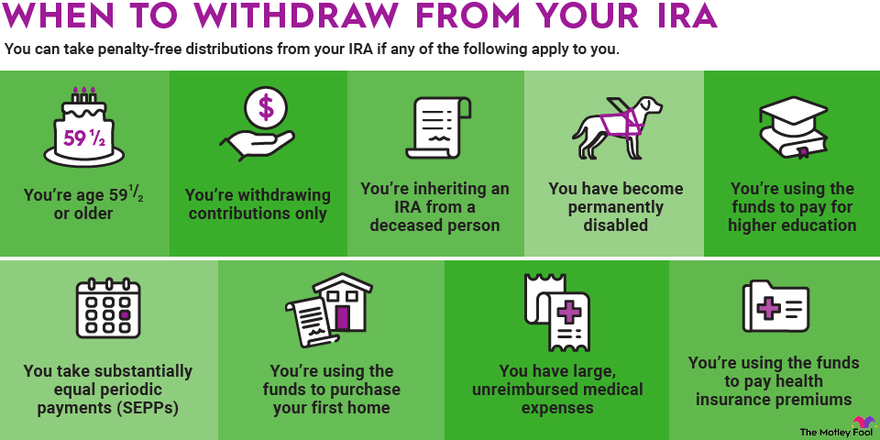
Several exceptions allow you to withdraw funds from your retirement account before age 59 ½ without incurring the 10% penalty. These exceptions vary depending on the type of account and the specific circumstances.
- Hardship Withdrawal (401(k)): You may be able to take a hardship withdrawal from your 401(k) if you have an immediate and heavy financial need and no other resources available. Common hardships include medical expenses, purchase of a primary residence, tuition expenses, and funeral expenses. However, hardship withdrawals are generally taxed as ordinary income.
- Disability: If you become permanently and totally disabled, you can withdraw funds from your retirement account without penalty. You'll need to provide proof of your disability to the IRS.
- Death: If you inherit a retirement account, you can withdraw funds without penalty, regardless of your age. However, the withdrawals may be subject to income taxes, depending on the type of account and your relationship to the deceased.
- Qualified Domestic Relations Order (QDRO): If you're divorced and a QDRO is issued, you may be able to withdraw funds from your ex-spouse's retirement account without penalty.
- IRS Levy: If the IRS levies your retirement account, you can withdraw the funds without penalty.
- Unreimbursed Medical Expenses: For Traditional and Roth IRAs, you can withdraw funds penalty-free to the extent that your unreimbursed medical expenses exceed 7.5% of your adjusted gross income (AGI).
- Health Insurance Premiums (Unemployed): If you're unemployed, you can withdraw funds from your IRA to pay for health insurance premiums without penalty.
- First-Time Homebuyer (IRA): You can withdraw up to $10,000 from your IRA to purchase or build a first home without penalty.
- Higher Education Expenses (IRA): You can withdraw funds from your IRA to pay for qualified higher education expenses for yourself, your spouse, your children, or your grandchildren.
- Substantially Equal Periodic Payments (SEPP): This allows you to take a series of substantially equal periodic payments from your IRA or 401(k) based on your life expectancy. If you follow the rules, you can avoid the 10% penalty. However, it's crucial to consult with a financial advisor before establishing a SEPP, as there are strict requirements.
The Withdrawal Process
The specific steps for withdrawing money from your retirement account will vary depending on the type of account and the financial institution holding the funds.
Withdrawing from an IRA
To withdraw funds from an IRA, you'll typically need to contact the financial institution where your account is held. They will provide you with the necessary forms to complete. You'll need to specify the amount you want to withdraw and how you want to receive the funds (e.g., check, electronic transfer).
Withdrawing from a 401(k)
Withdrawing from a 401(k) usually requires contacting your employer's benefits administrator or the plan administrator. They will provide you with the necessary forms and instructions. You may also be able to initiate the withdrawal process online through your 401(k) provider's website.
Tax Implications of Retirement Account Withdrawals
Withdrawals from most retirement accounts (Traditional IRA, 401(k)) are taxed as ordinary income. This means the withdrawn amount will be added to your taxable income for the year, and you'll pay taxes at your marginal tax rate. Roth IRA withdrawals are generally tax-free in retirement, as the contributions were made after-tax.
Withholding Taxes
When you withdraw funds from your retirement account, the financial institution is required to withhold a certain percentage for federal income taxes. You can choose to have more taxes withheld to cover your tax liability. It's important to consider your overall tax situation when deciding how much to withhold.
Alternatives to Withdrawing from Retirement Accounts
Before withdrawing funds from your retirement account, it's essential to explore other options. Withdrawing from your retirement savings can significantly impact your long-term financial security.
Emergency Fund
Ideally, you should have an emergency fund to cover unexpected expenses. This fund should be separate from your retirement savings and easily accessible.
Loans
Consider taking out a loan instead of withdrawing from your retirement account. While you'll have to pay interest on the loan, you won't face penalties or reduce your retirement savings.
Reducing Expenses
Look for ways to reduce your expenses to free up cash flow. This could involve cutting back on discretionary spending, negotiating lower rates on bills, or finding a less expensive place to live.
Seek Professional Advice
Navigating the complexities of retirement account withdrawals can be challenging. It's always a good idea to consult with a qualified financial advisor or tax professional before making any decisions. They can help you understand the rules and regulations, assess your financial situation, and develop a plan that meets your specific needs.

0 Comments