
Understanding 401(k) Rollovers and Annuities
Planning for retirement involves making crucial decisions about your savings. One common scenario is considering what to do with your 401(k) when you leave a job or retire. A 401(k) rollover is the process of moving funds from your employer-sponsored 401(k) plan to another retirement account. One potential destination for these funds is an annuity. But what are the implications of rolling over your 401(k) into an annuity, and is it the right choice for you? This guide will explore the various 401(k) rollover options to annuities, helping you make an informed decision.
What is a 401(k) Rollover?
A 401(k) rollover is the transfer of funds from your existing 401(k) account into a new retirement account. This is often done when you change jobs, retire, or simply want to consolidate your retirement savings. The primary benefit of a rollover is that it allows you to maintain the tax-deferred status of your retirement savings, meaning you won't incur immediate taxes on the transferred funds.
Types of 401(k) Rollovers
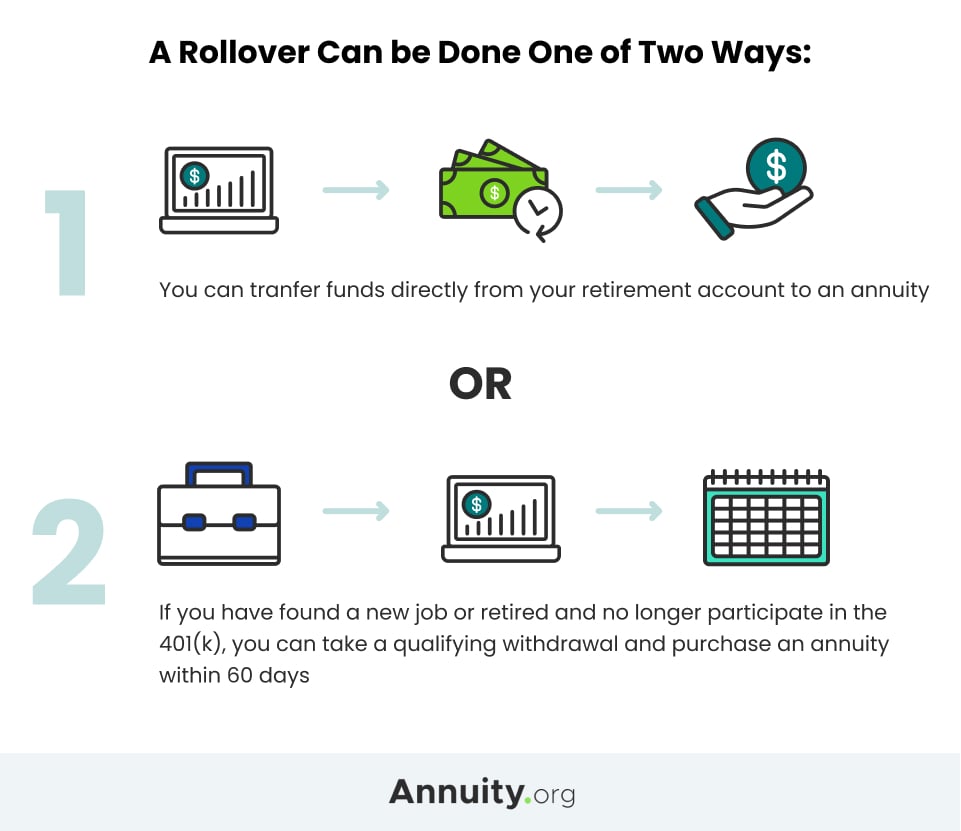
There are two main types of 401(k) rollovers:
- Direct Rollover: In a direct rollover, your 401(k) provider directly transfers the funds to your new retirement account. This is typically the preferred method as it minimizes the risk of tax complications.
- Indirect Rollover: In an indirect rollover, you receive a check for the distribution amount. You then have 60 days to deposit the funds into a new retirement account. If you fail to do so within the 60-day window, the distribution will be considered taxable income, and you may face penalties.
What is an Annuity?
An annuity is a contract between you and an insurance company. You make either a lump-sum payment or a series of payments, and in return, the insurance company promises to provide you with a stream of income, either immediately or at a future date. Annuities are often used as a retirement income tool, providing a guaranteed income stream that can supplement Social Security and other retirement savings.
Types of Annuities
Annuities come in various forms, each with its own features and benefits:
- Immediate Annuity: An immediate annuity begins paying out income shortly after you purchase it, typically within a year. This type of annuity is suitable for individuals who need immediate income.
- Deferred Annuity: A deferred annuity accumulates value over time, and payments begin at a later date. This type of annuity is ideal for those who want to save for retirement and defer taxes on their investment growth.
- Fixed Annuity: A fixed annuity offers a guaranteed interest rate for a specified period. This provides a predictable return and protects your principal from market volatility.
- Variable Annuity: A variable annuity allows you to invest your money in a range of subaccounts, similar to mutual funds. The value of your annuity will fluctuate based on the performance of these investments. While offering the potential for higher returns, variable annuities also carry greater risk.
- Indexed Annuity: An indexed annuity credits interest based on the performance of a market index, such as the S&P 500. While your returns are linked to the market, they are typically capped, limiting your potential gains. Indexed annuities also offer downside protection, ensuring that you won't lose money due to market declines.
401(k) Rollover Options to Annuities: The Process
Rolling over your 401(k) into an annuity involves several steps. First, you need to determine the type of annuity that best suits your retirement goals and risk tolerance. Then, you'll need to contact your 401(k) provider and request a rollover. They will provide you with the necessary paperwork and instructions.
Once you've completed the paperwork, your 401(k) provider will either send a check directly to the annuity provider (direct rollover) or to you (indirect rollover). If you receive a check, you'll need to deposit it into the annuity account within 60 days to avoid taxes and penalties.
Advantages of Rolling Over Your 401(k) into an Annuity
There are several potential benefits to rolling over your 401(k) into an annuity:
Guaranteed Income Stream
One of the primary advantages of an annuity is the guaranteed income stream it provides. This can be particularly appealing for retirees who are concerned about outliving their savings. An annuity can offer a reliable source of income that supplements Social Security and other retirement income.
Tax-Deferred Growth
Annuities offer tax-deferred growth, meaning you won't pay taxes on the earnings until you withdraw them. This can allow your investments to grow more quickly over time, as you're not losing a portion of your returns to taxes each year.
Principal Protection (in Some Cases)
Fixed and indexed annuities offer a degree of principal protection. Fixed annuities guarantee a minimum interest rate, while indexed annuities protect against market losses. This can provide peace of mind for retirees who are concerned about preserving their capital.
Disadvantages of Rolling Over Your 401(k) into an Annuity
While annuities offer several advantages, there are also potential drawbacks to consider:
Fees and Expenses
Annuities often come with fees and expenses, including mortality and expense (M&E) fees, administrative fees, and surrender charges. These fees can eat into your returns and reduce the overall value of your annuity.
Lack of Liquidity
Annuities can be less liquid than other retirement investments. Surrender charges may apply if you withdraw funds before the end of the surrender period, which can last for several years. This lack of liquidity can be a concern if you anticipate needing access to your funds in the future.
Complexity
Annuities can be complex financial products, making it difficult to understand all the terms and conditions. It's important to carefully review the contract and seek professional advice before investing in an annuity.
Opportunity Cost
By rolling over your 401(k) into an annuity, you may be giving up the potential for higher returns that could be achieved through other investments, such as stocks or mutual funds. This is particularly true for variable annuities, where the returns are linked to the performance of the underlying investments.
Factors to Consider Before Rolling Over Your 401(k) into an Annuity
Before deciding to roll over your 401(k) into an annuity, consider the following factors:
Your Retirement Goals
What are your retirement goals? Are you primarily concerned about generating a guaranteed income stream, or are you more focused on maximizing your investment returns? Your retirement goals will help you determine whether an annuity is the right choice for you.
Your Risk Tolerance
How comfortable are you with risk? If you're risk-averse, a fixed or indexed annuity may be a good option. If you're willing to take on more risk for the potential of higher returns, a variable annuity might be more suitable.
Your Time Horizon
How long do you have until retirement? If you have a long time horizon, you may be able to afford to take on more risk in your investments. If you're close to retirement, you may want to focus on preserving your capital and generating a reliable income stream.
Your Financial Situation
What is your overall financial situation? Do you have other sources of retirement income, such as Social Security or a pension? How much do you need to withdraw each month to cover your expenses? Your financial situation will help you determine how much of your 401(k) you should allocate to an annuity.
Seek Professional Advice
Consider consulting with a qualified financial advisor who can help you evaluate your options and make an informed decision. A financial advisor can assess your individual circumstances and recommend the best course of action for your retirement savings.

0 Comments