
Understanding the Metaverse: A Deep Dive
The metaverse, a term that has rapidly gained traction in recent years, represents a paradigm shift in how we interact with the digital world. It's not just about virtual reality (VR) or augmented reality (AR); it's about creating persistent, shared, 3D virtual worlds accessible through various devices, where users can interact with each other, engage in activities, and even conduct business.
Think of the metaverse as an evolution of the internet, moving from a flat, two-dimensional experience to an immersive, three-dimensional one. It's a space where digital and physical realities converge, blurring the lines between the real world and the virtual realm. This convergence allows for a wide range of possibilities, from attending virtual concerts and exploring digital art galleries to collaborating with colleagues in a virtual office and building entire digital economies.
Key Characteristics of the Metaverse
Several key characteristics define the metaverse and distinguish it from traditional online experiences:
- Persistence: The metaverse is not a temporary or fleeting experience. It exists continuously, even when you're not actively participating. Just like the real world, the metaverse continues to evolve and change regardless of your presence.
- Real-time Interaction: Users can interact with each other and the environment in real-time, fostering a sense of presence and community. This interaction goes beyond simple text-based communication, allowing for voice, gestures, and even haptic feedback.
- Interoperability: Ideally, the metaverse should be interoperable, meaning users can seamlessly move between different virtual worlds and platforms with their avatars and digital assets. This level of interoperability is still a work in progress, but it's a crucial element for the metaverse's long-term success.
- Decentralization: While some metaverse platforms are centralized, the ideal vision of the metaverse is decentralized, meaning it's not controlled by a single entity. This decentralization allows for greater user autonomy and control over their data and digital assets.
- Economy: The metaverse features its own digital economy, where users can create, buy, sell, and trade virtual goods and services. This economy is often powered by blockchain technology and cryptocurrencies.
The Role of Cryptocurrency in the Metaverse
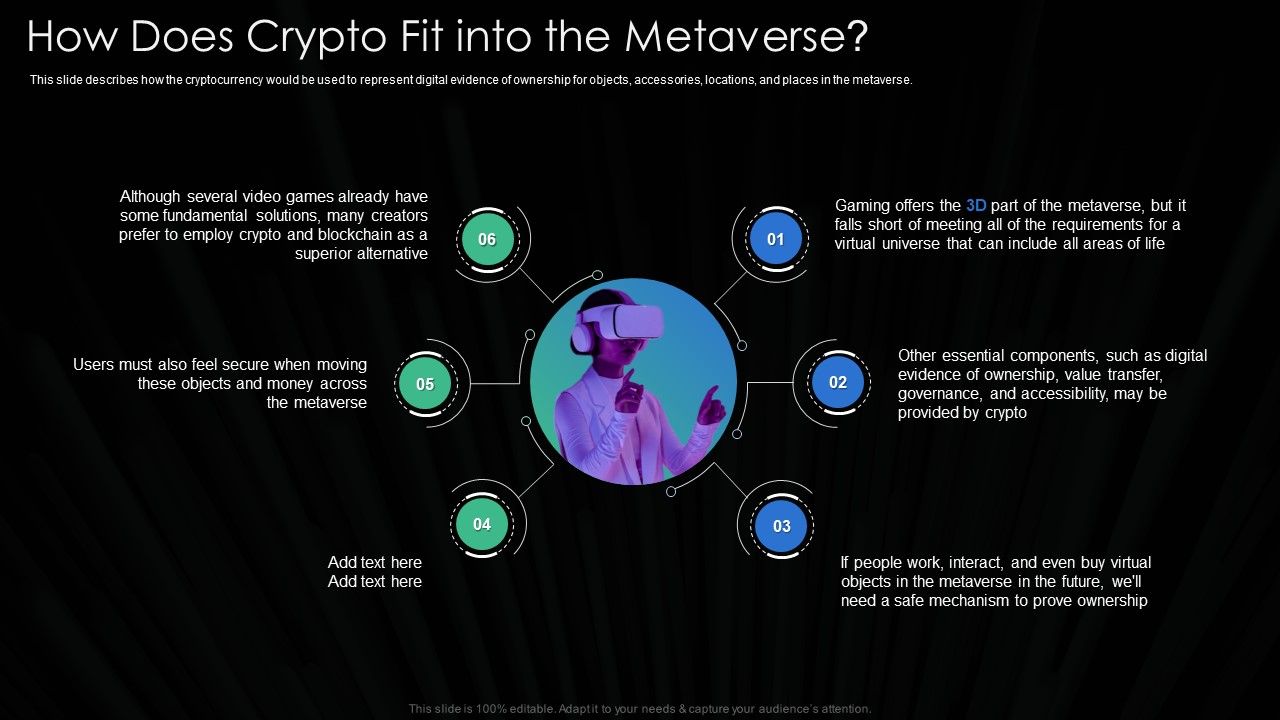
Cryptocurrency plays a pivotal role in the development and functionality of the metaverse. It provides the foundation for a decentralized and secure digital economy, enabling seamless transactions and ownership of virtual assets. Without cryptocurrency, the metaverse would likely be a more centralized and controlled environment, limiting user autonomy and innovation.
Cryptocurrencies as the Native Currency of the Metaverse
Cryptocurrencies act as the native currency within many metaverse platforms. They allow users to buy and sell virtual land, avatars, in-game items, and other digital assets. The use of cryptocurrency eliminates the need for traditional financial intermediaries, reducing transaction fees and streamlining the process of buying and selling digital goods.
For example, platforms like Decentraland and The Sandbox utilize their own native cryptocurrencies, MANA and SAND respectively, to facilitate transactions within their virtual worlds. Users can use these cryptocurrencies to purchase land, create and monetize content, and participate in governance decisions.
NFTs: Proving Ownership in the Metaverse
Non-fungible tokens (NFTs) are another crucial component of the metaverse economy. NFTs are unique digital assets that represent ownership of a specific item, whether it's a virtual piece of art, a collectible item, or a piece of virtual land. NFTs are stored on a blockchain, providing a secure and transparent record of ownership.
In the metaverse, NFTs are used to represent ownership of virtual assets, allowing users to prove that they own a particular item and to transfer ownership to others. This is particularly important for creating a thriving digital economy, as it allows users to buy and sell unique virtual assets with confidence.
Blockchain Technology: The Foundation of Security and Transparency
Blockchain technology, the underlying technology behind cryptocurrencies and NFTs, provides the security and transparency needed for a thriving metaverse economy. Blockchain is a decentralized and immutable ledger that records all transactions in a secure and transparent manner.
This transparency is crucial for building trust within the metaverse, as it allows users to verify the authenticity and ownership of digital assets. The decentralized nature of blockchain also ensures that no single entity can control the metaverse economy, promoting greater user autonomy and innovation.
Decentralized Autonomous Organizations (DAOs) and Metaverse Governance
Decentralized Autonomous Organizations (DAOs) are emerging as a key mechanism for governing metaverse platforms. DAOs are community-led organizations that use blockchain technology to manage and operate a project or platform. They allow users to participate in decision-making processes and contribute to the development of the metaverse.
In the metaverse, DAOs can be used to manage virtual land, allocate resources, and make decisions about the platform's future direction. This decentralized governance model empowers users and ensures that the metaverse evolves in a way that benefits the entire community.
Examples of Metaverse and Cryptocurrency Integration
Many existing platforms demonstrate the integration of metaverse concepts and cryptocurrency:
Decentraland
Decentraland is a virtual world built on the Ethereum blockchain, where users can buy, sell, and develop virtual land. The platform uses MANA, its native cryptocurrency, for all transactions. Users can create and monetize content on their land, attend virtual events, and interact with other users.
The Sandbox
The Sandbox is another popular metaverse platform that allows users to create and monetize their own gaming experiences. The platform uses SAND, its native cryptocurrency, and NFTs to represent ownership of virtual assets. Users can create and share their games with others, earning SAND in the process.
Axie Infinity
Axie Infinity is a play-to-earn game that utilizes NFTs and cryptocurrency. Players collect, breed, and battle digital creatures called Axies, which are represented as NFTs. Players can earn Smooth Love Potion (SLP), a cryptocurrency, by playing the game, which can then be used to breed new Axies or traded on cryptocurrency exchanges.
These examples illustrate how cryptocurrency and NFTs are being used to create thriving digital economies within the metaverse, empowering users and fostering innovation.

0 Comments