
What is Cost Segregation and Why Should Real Estate Investors Care?
Cost segregation is a powerful tax planning strategy that allows real estate investors to accelerate depreciation deductions on their properties. Instead of depreciating the entire building over a standard period (27.5 years for residential rental property and 39 years for commercial property), cost segregation studies identify building components that can be depreciated over shorter periods, such as 5, 7, or 15 years. This results in a larger tax deduction in the early years of ownership, freeing up cash flow for further investments.
Understanding Depreciation and Its Impact on Real Estate Investments
Depreciation is a non-cash expense that allows you to deduct a portion of the cost of your property each year. This deduction reduces your taxable income, lowering your tax liability. While standard depreciation is beneficial, cost segregation takes it a step further by maximizing the depreciation deductions in the initial years of ownership. This is particularly advantageous for investors looking to reinvest profits or reduce their overall tax burden.
The Standard Depreciation Method
Without cost segregation, the entire building is typically depreciated using the straight-line method over 27.5 or 39 years. This means an equal amount is deducted each year. While simple, it often overlooks opportunities to accelerate depreciation on certain building components.
How Cost Segregation Accelerates Depreciation
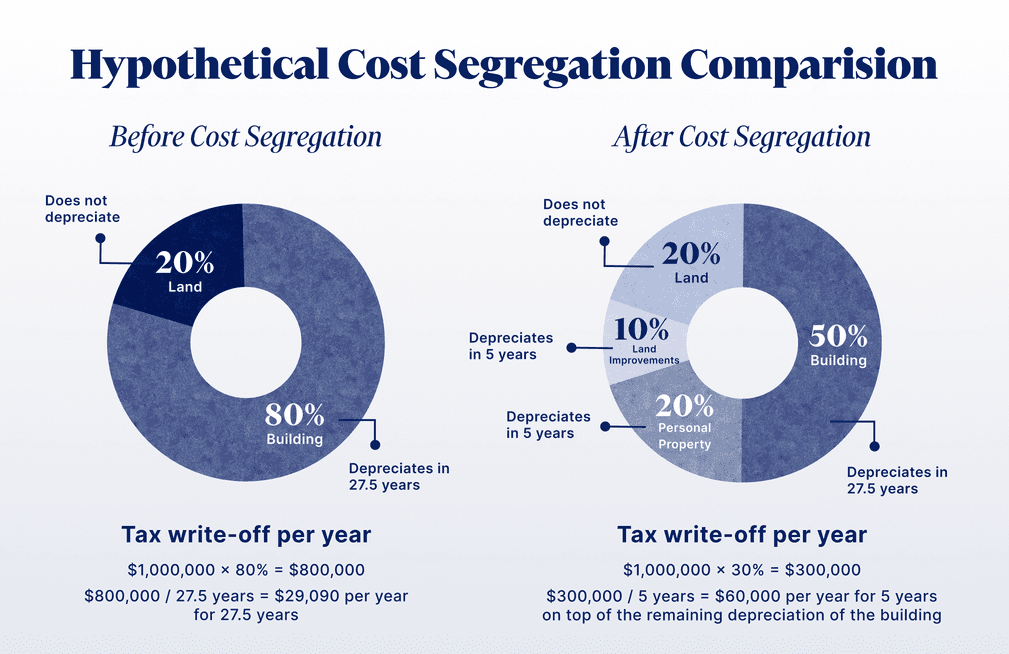
Cost segregation studies involve a detailed analysis of the building's components, classifying them into different asset classes with varying depreciation lives. For example, items like carpeting, certain types of flooring, decorative lighting, and specialized electrical or plumbing systems might be classified as personal property with a shorter depreciation life of 5 or 7 years. Land improvements, such as landscaping, sidewalks, and fences, may be depreciated over 15 years. By allocating costs to these shorter-lived assets, you can claim larger depreciation deductions in the early years of ownership.
Who Benefits Most from Cost Segregation Studies?
Cost segregation is most beneficial for real estate investors who:
- Own newly constructed buildings.
- Have recently renovated or remodeled existing properties.
- Have purchased a commercial property.
- Are seeking to reduce their current tax liability.
- Are looking to increase cash flow from their real estate investments.
While cost segregation can be beneficial for a wide range of properties, it's particularly impactful for properties with significant non-structural components. The higher the value of these components, the greater the potential tax savings.
Examples of Assets that Can Be Reclassified for Faster Depreciation
A cost segregation study will identify various assets within a building that can be depreciated over shorter periods. Some common examples include:
- Specialized Flooring: Certain types of flooring, such as decorative tile or carpeting, may qualify for a shorter depreciation life.
- Decorative Lighting: Lighting fixtures that are primarily decorative rather than structural can often be depreciated faster.
- Electrical and Plumbing Systems Serving Specific Equipment: Electrical wiring and plumbing dedicated to specific equipment, such as manufacturing machinery, may be eligible for accelerated depreciation.
- Landscaping: Landscaping features like shrubs, trees, and irrigation systems are typically depreciated over 15 years.
- Removable Wall Coverings: Wallpaper and other removable wall coverings may qualify for a shorter depreciation life.
- Specialized HVAC Systems: HVAC systems that serve specific areas, such as computer rooms or laboratories, may be eligible for accelerated depreciation.
This is not an exhaustive list, and the specific assets that can be reclassified will depend on the individual property.
The Cost Segregation Study Process: What to Expect
A cost segregation study is typically performed by a qualified engineer or tax professional with expertise in real estate and depreciation. The process generally involves the following steps:
- Initial Consultation: The professional will review your property information and discuss your goals to determine if a cost segregation study is appropriate.
- Property Inspection: A site visit is conducted to inspect the building and identify assets that can be reclassified.
- Data Collection: The professional will gather information on construction costs, blueprints, and other relevant documents.
- Cost Allocation: Costs are allocated to different asset classes based on their function and depreciation life.
- Report Preparation: A detailed report is prepared, outlining the findings of the study and the resulting tax savings.
- IRS Audit Support: The professional should be available to support the study in the event of an IRS audit.
Potential Tax Savings and ROI of a Cost Segregation Study
The potential tax savings from a cost segregation study can be significant, often resulting in thousands or even tens of thousands of dollars in reduced tax liability. The exact amount of savings will depend on the size and complexity of the property, as well as the applicable tax laws. The return on investment (ROI) for a cost segregation study is typically very high, often exceeding 10:1 or even higher. This makes it a valuable investment for real estate investors looking to maximize their tax benefits and improve their cash flow.
Example Scenario:
Let's say you purchase a commercial property for $1 million. Without cost segregation, you would depreciate the entire building over 39 years. However, a cost segregation study identifies $200,000 worth of assets that can be depreciated over 5 years and $100,000 worth of assets that can be depreciated over 15 years. This accelerated depreciation would result in significantly larger tax deductions in the early years of ownership, freeing up cash flow for other investments.
Choosing the Right Cost Segregation Professional
Selecting a qualified and experienced cost segregation professional is crucial to ensure the accuracy and reliability of the study. Look for a professional with the following qualifications:
- Engineering or Tax Background: A strong understanding of both engineering and tax principles is essential.
- Experience: Choose a professional with a proven track record of performing cost segregation studies.
- Certification: Consider professionals who are certified by organizations such as the American Society of Cost Segregation Professionals (ASCSP).
- IRS Audit Support: Ensure the professional offers support in the event of an IRS audit.
- References: Ask for references from previous clients.
Don't be afraid to shop around and compare quotes from different professionals. The cost of a cost segregation study will vary depending on the size and complexity of the property, but it's an investment that can pay for itself many times over.
Common Misconceptions About Cost Segregation
There are several common misconceptions about cost segregation that can prevent real estate investors from taking advantage of this valuable tax strategy:
- It's only for large properties: While cost segregation is often associated with large commercial properties, it can also be beneficial for smaller properties, especially those with recent renovations.
- It's too expensive: The cost of a cost segregation study is often outweighed by the potential tax savings.
- It's too complicated: While the process may seem complex, a qualified professional can handle all the details.
- It will trigger an IRS audit: A properly prepared cost segregation study is unlikely to trigger an audit. In fact, it can help to support your depreciation deductions in the event of an audit.
By understanding the benefits and dispelling these misconceptions, real estate investors can make informed decisions about whether a cost segregation study is right for them.

0 Comments