
The Intricate Dance: Unemployment and Inflation
Unemployment and inflation are two of the most closely watched economic indicators. They paint a picture of the overall health and stability of a country's economy. While seemingly disparate, they are often intertwined in a complex relationship that economists have studied and debated for decades. Understanding this relationship is crucial for policymakers aiming to steer the economy towards prosperity.
Defining Unemployment and Inflation
Before diving into their connection, it's important to define each term clearly.
Unemployment: A Measure of Joblessness
Unemployment refers to the percentage of the labor force that is actively seeking employment but unable to find a job. The labor force includes all people of working age who are either employed or actively seeking employment. It excludes those who are not actively looking for work, such as students, retirees, and discouraged workers (those who have given up searching for a job).
The unemployment rate is a key indicator of the labor market's health. A high unemployment rate suggests a weak economy with limited job opportunities, while a low unemployment rate indicates a strong economy with ample job openings.
Inflation: The Rising Tide of Prices
Inflation is the rate at which the general level of prices for goods and services is rising, and subsequently, purchasing power is falling. It's typically expressed as a percentage increase in the Consumer Price Index (CPI), which measures the average change over time in the prices paid by urban consumers for a basket of consumer goods and services.
Moderate inflation is generally considered healthy for an economy, as it encourages spending and investment. However, high or hyperinflation can erode purchasing power, distort economic signals, and destabilize the economy.
The Phillips Curve: A Historical Perspective
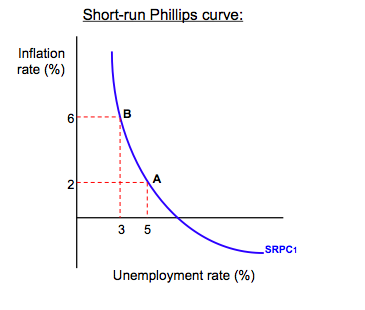
The most well-known framework for understanding the relationship between unemployment and inflation is the Phillips Curve. Developed by economist A.W. Phillips in 1958, the Phillips Curve initially suggested an inverse relationship between unemployment and inflation: as unemployment decreases, inflation increases, and vice versa.
Phillips based his findings on data from the United Kingdom, observing that periods of low unemployment tended to coincide with periods of high wage inflation (which often translates into higher prices for goods and services). The logic behind this relationship is relatively straightforward: when unemployment is low, businesses have to compete more fiercely for workers, leading to higher wages. These higher wages, in turn, can lead to increased production costs and ultimately higher prices for consumers.
The Short-Run vs. the Long-Run Phillips Curve
While the original Phillips Curve held sway for some time, its predictive power began to wane in the 1970s. The stagflation of that era – a period of high inflation and high unemployment – presented a challenge to the traditional Phillips Curve. Economists Milton Friedman and Edmund Phelps argued that the Phillips Curve only held true in the short run.
The Short-Run Phillips Curve (SRPC)
In the short run, there may indeed be a trade-off between unemployment and inflation. Policymakers might be able to temporarily reduce unemployment by stimulating demand, even if it means accepting a slightly higher rate of inflation. This is because wages and prices may not immediately adjust to changes in economic conditions.
The Long-Run Phillips Curve (LRPC)
However, Friedman and Phelps argued that in the long run, there is no trade-off between unemployment and inflation. They introduced the concept of the "natural rate of unemployment," which is the unemployment rate that prevails when the economy is operating at its potential output level. This rate includes frictional unemployment (people temporarily between jobs) and structural unemployment (unemployment due to a mismatch between skills and available jobs).
According to this view, any attempt to push unemployment below the natural rate will only lead to accelerating inflation. Workers will eventually realize that their wages are not keeping pace with rising prices and will demand even higher wages, leading to a wage-price spiral. In the long run, the Phillips Curve becomes vertical at the natural rate of unemployment, indicating that there is no permanent trade-off between unemployment and inflation.
Factors Influencing the Relationship
The relationship between unemployment and inflation is not always straightforward and can be influenced by various factors, including:
Supply Shocks
Supply shocks, such as a sudden increase in oil prices, can lead to both higher inflation and higher unemployment. This is because higher input costs can force businesses to raise prices (leading to inflation) and reduce production (leading to layoffs and higher unemployment).
Expectations
Inflation expectations play a crucial role in shaping the relationship between unemployment and inflation. If people expect inflation to rise, they will demand higher wages and prices, which can fuel actual inflation. Central banks closely monitor inflation expectations to gauge the potential for future inflation pressures.
Government Policies
Government policies, such as fiscal stimulus or monetary policy interventions, can influence both unemployment and inflation. Expansionary fiscal policy (e.g., increased government spending) can stimulate demand and reduce unemployment, but it can also lead to higher inflation. Similarly, expansionary monetary policy (e.g., lower interest rates) can boost economic activity but may also fuel inflation.
Global Economic Conditions
Global economic conditions, such as changes in exchange rates or international trade patterns, can also affect unemployment and inflation. For example, a strong dollar can make imports cheaper (reducing inflation) but can also make exports more expensive (potentially increasing unemployment).
Beyond the Phillips Curve: Alternative Perspectives
While the Phillips Curve remains a central framework, some economists offer alternative perspectives on the relationship between unemployment and inflation.
Modern Monetary Theory (MMT)
Modern Monetary Theory (MMT) challenges the traditional view that governments face a strict budget constraint. MMT proponents argue that a sovereign government that issues its own currency can finance its spending without necessarily causing inflation, as long as there are unemployed resources in the economy. They suggest that inflation is more likely to be caused by supply-side constraints or excessive demand relative to the economy's productive capacity.
The Role of Technology
Technological advancements are also reshaping the labor market and the relationship between unemployment and inflation. Automation and artificial intelligence are displacing some jobs, while creating new ones that require different skills. This can lead to structural unemployment and may dampen wage pressures, even when the overall unemployment rate is low.

0 Comments