
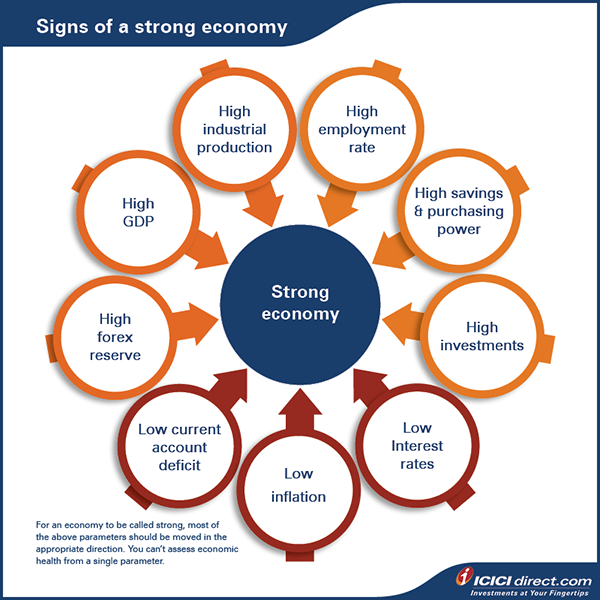
What are Economic Indicators and Why Do They Matter?
Economic indicators are pieces of economic data, usually of macroeconomic scale, that are used by analysts to interpret current or future investment possibilities, and to judge the overall health of an economy. They provide insights into various aspects of economic performance, such as production, employment, inflation, and consumer spending. Understanding these indicators is crucial for businesses, investors, and policymakers to make informed decisions and navigate the complex economic landscape.
A strong economy typically exhibits positive trends across several key indicators, signaling sustainable growth, stability, and prosperity. Monitoring these indicators allows us to assess the current state of the economy, predict future trends, and identify potential risks.
Key Economic Indicators of a Strong Economy
Several key indicators provide valuable insights into the health and strength of an economy. These indicators can be broadly categorized into different areas, including production, employment, inflation, and consumer activity.
Gross Domestic Product (GDP)
Gross Domestic Product (GDP) is perhaps the most widely recognized and comprehensive measure of a nation's economic activity. It represents the total value of all goods and services produced within a country's borders during a specific period, typically a quarter or a year. A rising GDP indicates economic growth, while a declining GDP suggests a contraction or recession.
A strong economy generally experiences consistent and sustainable GDP growth. This growth reflects increased production, higher incomes, and greater overall economic activity. However, it's important to consider the *quality* of GDP growth. Is it driven by sustainable factors like innovation and productivity, or by unsustainable factors like excessive debt or asset bubbles? A healthy GDP growth rate is typically considered to be between 2-3% annually.
Unemployment Rate
The unemployment rate measures the percentage of the labor force that is actively seeking employment but unable to find it. A low unemployment rate is generally indicative of a healthy economy, as it suggests that most people who want to work are able to find jobs. A high unemployment rate, on the other hand, can signal economic weakness and hardship.
A strong economy typically has a low and stable unemployment rate. This indicates that businesses are hiring, consumers are spending, and the overall economic outlook is positive. The "natural rate of unemployment," which represents the level of unemployment that exists even in a healthy economy due to frictional and structural factors, varies from country to country but is often around 4-5%.
Inflation Rate
Inflation refers to the rate at which the general level of prices for goods and services is rising, and subsequently, purchasing power is falling. A moderate level of inflation is often considered healthy for an economy, as it encourages spending and investment. However, high or uncontrolled inflation can erode purchasing power, distort economic signals, and lead to instability.
Central banks typically target a specific inflation rate, often around 2%, to maintain price stability. A strong economy generally experiences stable and predictable inflation, allowing businesses and consumers to plan for the future with confidence. Deflation, or a sustained decrease in the general price level, can be even more harmful than high inflation, as it can lead to decreased spending and investment.
Consumer Spending
Consumer spending is a major driver of economic activity in most developed economies. It represents the total amount of money spent by households on goods and services. Strong consumer spending indicates confidence in the economy and a willingness to spend money, which in turn fuels economic growth.
Several factors can influence consumer spending, including income levels, consumer confidence, interest rates, and inflation expectations. High consumer confidence, low interest rates, and rising incomes typically lead to increased spending. Monitoring retail sales, consumer confidence surveys, and personal consumption expenditure data can provide valuable insights into the health of consumer spending.
Housing Market Indicators
The housing market is a significant sector of the economy, and its performance can provide valuable insights into overall economic health. Key housing market indicators include housing starts, existing home sales, and home prices.
Increased housing starts and home sales suggest strong demand for housing, which can stimulate construction activity and related industries. Rising home prices can also indicate a healthy economy, but excessive price appreciation can create a housing bubble and pose risks to financial stability. Monitoring these indicators can help assess the strength and stability of the housing market and its impact on the broader economy.
Manufacturing Activity
The manufacturing sector plays a crucial role in many economies, and its performance can be a leading indicator of overall economic health. The Purchasing Managers' Index (PMI) is a widely used indicator of manufacturing activity. A PMI above 50 indicates that the manufacturing sector is expanding, while a PMI below 50 suggests a contraction.
Strong manufacturing activity typically indicates increased production, higher employment, and greater overall economic activity. Monitoring the PMI and other manufacturing indicators can provide valuable insights into the health and strength of the manufacturing sector and its impact on the broader economy.
Interest Rates
Interest rates are the cost of borrowing money, and they play a significant role in influencing economic activity. Central banks use interest rates as a tool to manage inflation and stimulate or cool down the economy. Low interest rates encourage borrowing and spending, while high interest rates discourage borrowing and spending.
The level of interest rates is directly controlled by the central bank. The central bank may raise or lower rates depending on the overall economic situation and its monetary policy goals. Interest rates have an indirect effect on inflation, unemployment, and GDP growth. Lowering interest rates can lead to an increase in inflation, a decrease in unemployment, and an increase in GDP growth. Raising interest rates can lead to a decrease in inflation, an increase in unemployment, and a decrease in GDP growth.
Stock Market Performance
While not a direct measure of economic activity, the stock market can provide insights into investor sentiment and expectations about future economic performance. A rising stock market typically indicates optimism about the economy, while a falling stock market can signal concerns about economic prospects.
However, it's important to remember that the stock market is not always a perfect reflection of the underlying economy. Stock prices can be influenced by a variety of factors, including investor sentiment, global events, and company-specific news. While the stock market can be a useful indicator, it should be considered in conjunction with other economic data.
Trade Balance
The trade balance represents the difference between a country's exports and imports. A trade surplus (exports exceeding imports) can indicate a strong economy, as it suggests that the country is producing goods and services that are in demand globally. A trade deficit (imports exceeding exports) can signal economic weakness, but it can also reflect strong domestic demand.
Analyzing the composition of exports and imports can provide further insights into the health of the economy. For example, a country that exports high-value manufactured goods and imports raw materials is generally considered to have a stronger economy than a country that exports raw materials and imports manufactured goods.

0 Comments