
Understanding Enterprise Risk Management (ERM) for Financial Institutions
Financial institutions operate in a complex and dynamic environment, facing a multitude of risks that can impact their stability, profitability, and reputation. Effective Enterprise Risk Management (ERM) is crucial for navigating these challenges and ensuring long-term success. An ERM framework provides a structured and systematic approach to identifying, assessing, managing, and monitoring risks across the entire organization.
The Importance of an ERM Framework
A robust ERM framework offers numerous benefits to financial institutions. It helps to:
- Improve Decision-Making: By providing a comprehensive view of risks, ERM enables informed decision-making at all levels of the organization.
- Enhance Operational Efficiency: ERM streamlines risk management processes, reducing duplication and improving efficiency.
- Protect Capital and Reputation: Effective risk management minimizes losses and protects the institution's reputation from damage caused by adverse events.
- Ensure Regulatory Compliance: ERM helps institutions comply with regulatory requirements and avoid penalties.
- Increase Stakeholder Confidence: A well-managed risk profile builds confidence among investors, customers, and regulators.
Key Components of an ERM Framework
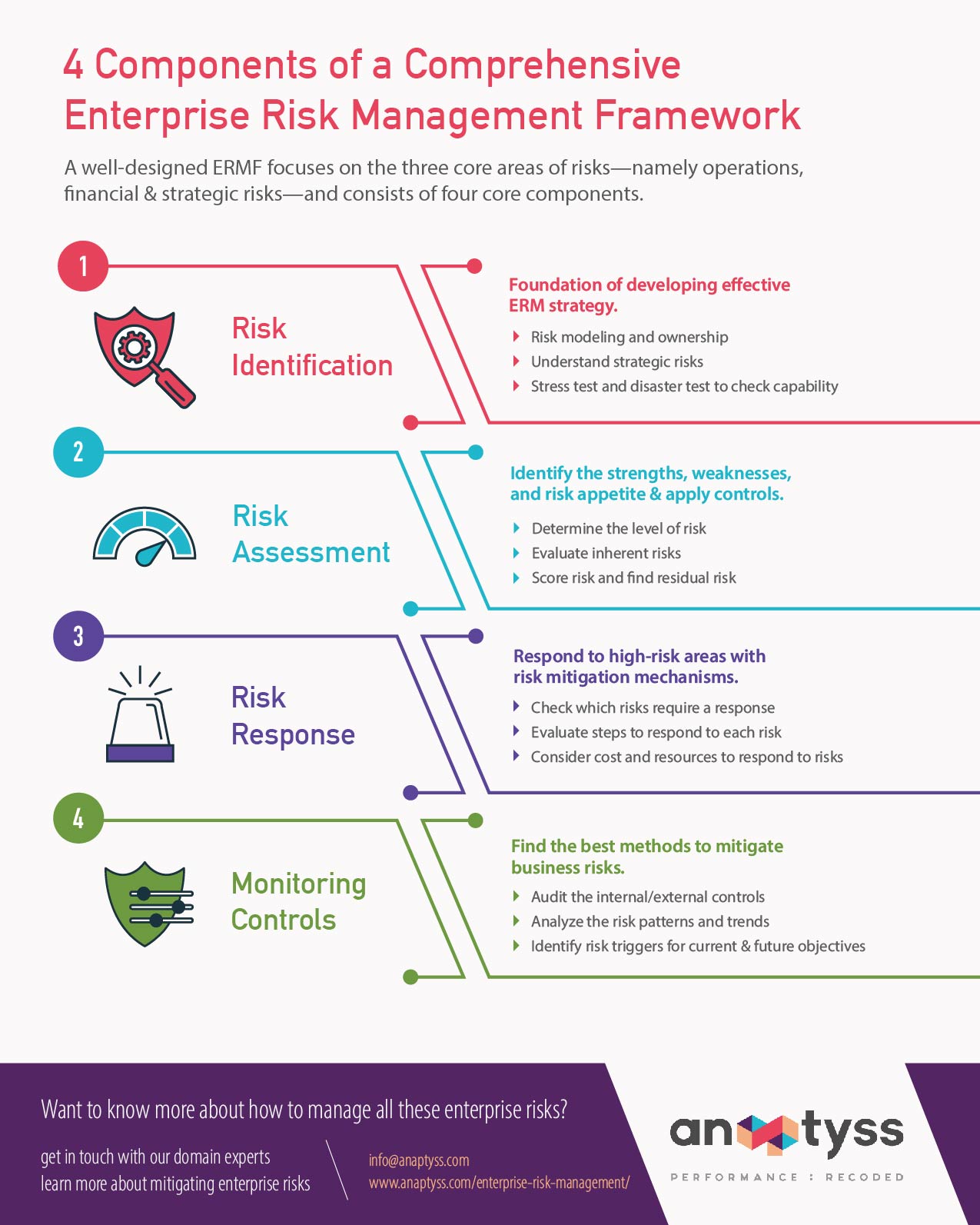
A typical ERM framework for financial institutions consists of several key components, each playing a vital role in the overall risk management process.
1. Governance and Organization
Strong governance is the foundation of an effective ERM framework. This includes:
- Board Oversight: The board of directors is ultimately responsible for overseeing the institution's risk management activities and ensuring that an appropriate ERM framework is in place.
- Risk Management Committee: A risk management committee, composed of senior management representatives, is responsible for developing and implementing the ERM framework.
- Chief Risk Officer (CRO): The CRO is responsible for leading the risk management function and providing independent oversight of risk-taking activities.
- Clear Roles and Responsibilities: Clearly defined roles and responsibilities for risk management at all levels of the organization are essential.
2. Risk Identification
The risk identification process involves identifying all potential risks that could impact the institution's objectives. This includes:
- Internal Analysis: Reviewing internal data, processes, and controls to identify potential weaknesses and vulnerabilities.
- External Analysis: Monitoring external factors such as economic conditions, regulatory changes, and competitive pressures.
- Scenario Analysis: Developing and analyzing potential scenarios to assess the impact of different events on the institution.
- Risk Workshops: Conducting workshops with key stakeholders to identify potential risks and brainstorm mitigation strategies.
3. Risk Assessment
Once risks have been identified, they need to be assessed in terms of their likelihood and impact. This involves:
- Qualitative Assessment: Assessing risks based on subjective factors such as expert judgment and historical data.
- Quantitative Assessment: Using statistical models and other quantitative techniques to estimate the potential financial impact of risks.
- Risk Mapping: Creating a visual representation of risks based on their likelihood and impact.
4. Risk Response
After assessing the risks, the institution needs to develop and implement appropriate risk responses. These responses may include:
- Risk Avoidance: Avoiding activities that pose unacceptable risks.
- Risk Mitigation: Implementing controls to reduce the likelihood or impact of risks.
- Risk Transfer: Transferring risks to a third party through insurance or other mechanisms.
- Risk Acceptance: Accepting risks that are within the institution's risk appetite.
5. Risk Monitoring and Reporting
The ERM framework should include ongoing monitoring and reporting to ensure that risks are being effectively managed. This involves:
- Key Risk Indicators (KRIs): Tracking KRIs to monitor the institution's risk profile and identify potential emerging risks.
- Regular Reporting: Providing regular reports to senior management and the board of directors on the institution's risk profile and risk management activities.
- Independent Review: Conducting independent reviews of the ERM framework to ensure its effectiveness.
Types of Risks Faced by Financial Institutions
Financial institutions face a wide range of risks, including:
Credit Risk
The risk of loss arising from a borrower's failure to repay a loan or meet contractual obligations. Effective credit risk management involves:
- Thorough credit analysis
- Diversification of the loan portfolio
- Collateralization
- Credit risk mitigation techniques (e.g., credit derivatives)
Market Risk
The risk of loss arising from changes in market conditions, such as interest rates, exchange rates, and equity prices. Effective market risk management involves:
- Setting risk limits
- Using hedging strategies
- Stress testing
- Monitoring market volatility
Operational Risk
The risk of loss resulting from inadequate or failed internal processes, people, and systems, or from external events. Effective operational risk management involves:
- Implementing strong internal controls
- Developing business continuity plans
- Training employees
- Managing cybersecurity risks
Liquidity Risk
The risk of not being able to meet financial obligations as they come due. Effective liquidity risk management involves:
- Maintaining adequate liquidity buffers
- Diversifying funding sources
- Stress testing liquidity positions
- Monitoring cash flows
Reputational Risk
The risk of damage to an institution's reputation, which can result in loss of customers, revenue, and market share. Effective reputational risk management involves:
- Maintaining high ethical standards
- Managing customer complaints effectively
- Responding to media inquiries promptly and accurately
- Protecting the institution's brand
Regulatory and Compliance Risk
The risk of sanctions, fines, or other penalties for non-compliance with laws, regulations, and supervisory requirements. Effective regulatory and compliance risk management involves:
- Staying abreast of regulatory changes
- Implementing compliance programs
- Conducting regular audits
- Providing compliance training to employees
Implementing an Effective ERM Framework
Implementing an effective ERM framework requires a commitment from senior management and the board of directors. It also requires a collaborative effort from all departments within the institution.
Key steps in implementing an ERM framework include:
- Conducting a gap analysis: Assessing the institution's current risk management practices and identifying areas for improvement.
- Developing an ERM policy: Establishing a clear statement of the institution's risk management philosophy and objectives.
- Designing the ERM framework: Developing the structure and processes for identifying, assessing, managing, and monitoring risks.
- Implementing the ERM framework: Putting the ERM framework into practice and training employees on their roles and responsibilities.
- Monitoring and evaluating the ERM framework: Regularly monitoring and evaluating the effectiveness of the ERM framework and making adjustments as needed.
By implementing a robust ERM framework, financial institutions can better manage their risks, protect their capital and reputation, and achieve their strategic objectives. It is a critical component of sound corporate governance and a key to long-term success in the ever-changing financial landscape.

0 Comments