
The Expanding Frontier: An Economic Overview of Space Exploration
Space exploration, once the exclusive domain of government agencies, is rapidly transforming into a dynamic industry with significant economic implications. Driven by technological advancements, private sector innovation, and a growing understanding of the potential benefits of space-based activities, the space exploration industry is poised for substantial growth in the coming decades. This article delves into the economic analysis of this burgeoning sector, exploring its current state, key drivers, and future prospects.
The Current State of the Space Economy
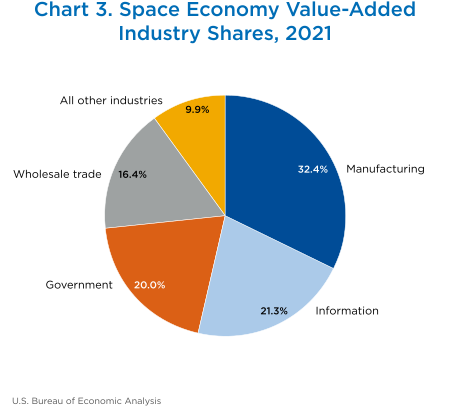
The "space economy" encompasses all public and private activities involved in developing, manufacturing, launching, and utilizing space-based assets and services. This includes satellite manufacturing and operation, launch services, ground equipment, and a growing range of applications from communications and navigation to Earth observation and resource management. While quantifying the exact size of the space economy is challenging, estimates generally place it in the hundreds of billions of dollars annually, with projections indicating continued expansion.
Traditionally, government spending has been the primary driver of the space economy, with agencies like NASA, ESA, and Roscosmos investing heavily in research, development, and exploration missions. However, the emergence of private space companies like SpaceX, Blue Origin, and Virgin Galactic has dramatically altered the landscape. These companies are not only competing with traditional government contractors but are also pioneering new business models and technologies, driving down costs and expanding access to space.
Key Sectors Within the Space Economy
The space economy can be broadly divided into several key sectors:
- Satellite Manufacturing and Operation: This sector involves the design, construction, launch, and operation of satellites for various purposes, including communication, navigation, Earth observation, and scientific research. It's a mature sector with established players and significant revenue streams.
- Launch Services: This sector focuses on providing access to space for satellites and other payloads. The emergence of reusable launch vehicles, pioneered by companies like SpaceX, is revolutionizing this sector by significantly reducing launch costs.
- Ground Equipment: This sector encompasses the infrastructure and equipment required to support space-based activities, including ground stations, tracking facilities, and data processing centers.
- Space-Based Applications: This sector includes the various applications that rely on space-based assets, such as GPS navigation, satellite television, weather forecasting, and Earth observation services. This is arguably the largest and most economically impactful sector of the space economy.
- Space Tourism and Exploration: This emerging sector is focused on providing opportunities for individuals to experience space travel and exploration. While still in its early stages, space tourism has the potential to become a significant driver of economic growth.
Economic Drivers of the Space Exploration Industry
Several factors are fueling the growth of the space exploration industry:
Technological Advancements
Advances in areas like rocketry, materials science, robotics, and artificial intelligence are making space exploration more affordable and accessible. Reusable launch vehicles, for example, have dramatically reduced the cost of launching payloads into orbit, opening up new opportunities for commercial space activities.
Private Sector Investment
Increased private sector investment is a major driver of growth in the space exploration industry. Venture capitalists, private equity firms, and wealthy individuals are pouring billions of dollars into space companies, fueling innovation and accelerating the development of new technologies. The promise of high returns and the potential to disrupt established industries are attracting significant investment.
Government Support and Policy
Government policies and regulations play a crucial role in shaping the space exploration industry. Supportive policies, such as tax incentives, grants, and public-private partnerships, can encourage private sector investment and innovation. Government agencies also continue to be important customers for space-based products and services, providing a stable source of revenue for the industry.
Resource Acquisition and Utilization
The prospect of accessing and utilizing resources from asteroids, the Moon, and Mars is a long-term driver of space exploration. These resources could include water ice, rare earth minerals, and other materials that are valuable for both space-based and terrestrial applications. While resource extraction in space is still in its early stages, it has the potential to revolutionize the space economy and create new industries.
Scientific Discovery and Exploration
The quest for scientific knowledge and the desire to explore the universe are fundamental drivers of space exploration. Discoveries about the origins of the universe, the formation of planets, and the possibility of life beyond Earth can inspire innovation, attract public support, and drive investment in space-related technologies.
Economic Impact of Space Exploration
The economic impact of space exploration extends far beyond the direct revenues generated by the space industry. Space exploration activities can stimulate innovation, create new jobs, and improve the quality of life for people on Earth.
Technological Spinoffs
Space exploration has led to numerous technological spinoffs that have benefited other industries. Examples include advanced materials, medical devices, computer technologies, and communication systems. These spinoffs can create new businesses, improve existing products and services, and contribute to overall economic growth.
Job Creation
The space exploration industry creates jobs in a wide range of fields, including engineering, science, manufacturing, and management. As the industry grows, it will create even more opportunities for skilled workers. Furthermore, the economic activity generated by the space industry can support jobs in related sectors, such as tourism, education, and research.
Improved Infrastructure
Investments in space infrastructure, such as satellite communication networks and Earth observation systems, can improve the efficiency and productivity of other industries. For example, GPS navigation systems have revolutionized transportation, logistics, and agriculture. Earth observation satellites provide valuable data for environmental monitoring, disaster management, and resource management.
Inspiration and Education
Space exploration can inspire young people to pursue careers in science, technology, engineering, and mathematics (STEM). By showcasing the wonders of the universe and the challenges of space exploration, it can spark curiosity and encourage innovation. Furthermore, space-related educational programs can improve students' understanding of science and technology, preparing them for future careers in the space industry and other STEM fields.
Challenges and Opportunities
While the space exploration industry holds immense promise, it also faces several challenges:
High Costs
Space exploration is inherently expensive, requiring significant investments in research, development, and infrastructure. Reducing the cost of access to space is critical for unlocking the full potential of the space economy.
Regulatory Uncertainty
The regulatory framework for space activities is still evolving, creating uncertainty for companies operating in the space industry. Clear and consistent regulations are needed to foster innovation and attract investment.
Environmental Concerns
Space activities can have environmental impacts, such as the generation of space debris and the pollution of launch sites. Sustainable practices are needed to minimize these impacts and ensure the long-term viability of space exploration.
Geopolitical Risks
Space exploration is increasingly becoming a domain of geopolitical competition, with countries vying for leadership in space technology and exploration. International cooperation is essential for mitigating these risks and ensuring the peaceful use of space.
Despite these challenges, the opportunities in the space exploration industry are vast. As technology advances, costs decline, and private sector investment increases, the space economy is poised for continued growth. By addressing the challenges and seizing the opportunities, the space exploration industry can contribute significantly to economic growth, technological innovation, and the advancement of human knowledge.

0 Comments